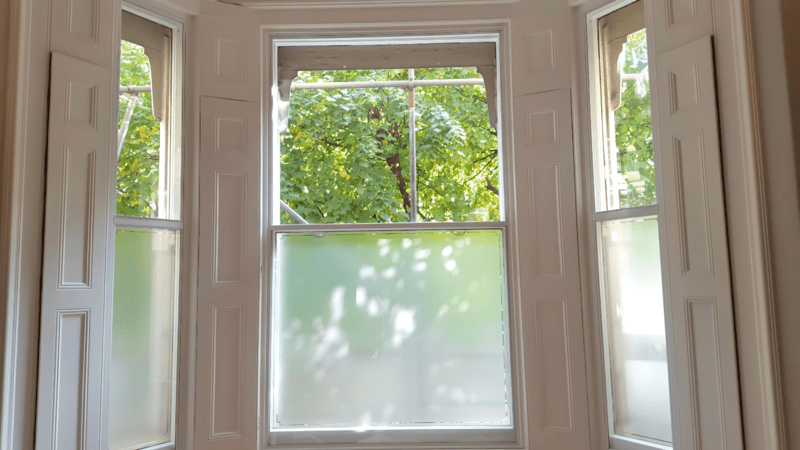
Bay windows are among the hardest windows to treat well. They have multiple panes at angles, non-standard sizes and a continuous line that is often the architectural feature of a Victorian or Georgian room. Secondary glazing can improve performance without replacing the original bay.
Why bay windows need a bespoke approach
Every bay is non-standard. The facets may meet at different angles, the reveals can vary from one section to the next, and the original windows may include sash boxes, glazing bars or curved details. In a period home, replacing the windows can destroy the character that makes the bay valuable in the first place.
A survey measures every facet rather than treating the bay as one rectangle. Each section is designed and glazed individually, then joined with matching couplers so the internal line stays continuous and the sightlines remain calm across the angles.
How the specification works
Bespoke manufacture is the norm. The team records the angle, width, height, reveal depth, existing frame condition and access requirements for each facet. The units are then joined to follow the geometry of the bay. Sealing every junction between facets is essential: a gap at a coupler can reduce the acoustic and thermal benefit of the whole installation.
The same acoustic laminated specification used for demanding window projects can be considered for a bay. Suitable installations can achieve up to 54dB noise reduction, or up to 80% quieter. The result depends on the seals at every facet, the original bay, the room and sound paths elsewhere in the building.
Thermally, a suitable specification can improve the window U-value from 5.0 to 1.8 W/m²K, a 64% heat-loss reduction through the window. The bay needs to be treated as one connected system for those results to be meaningful.
Heritage framing
The secondary units sit inside the existing reveal, leaving the original bay untouched. The system is fully reversible and the external appearance remains unchanged. Planning permission is typically not required for internal secondary glazing, making it conservation-area friendly, but listed building consent and local advice must still be checked.
Read the thermal guide and acoustic guide for the performance context. For wider heritage decisions, see our secondary versus double glazing comparison.
Verified cost for a large Georgian bay
A large Georgian bay up to 2,400 × 1,800mm starts at £2,565 per window installed including VAT. It is the largest unit in the range. Use the calculator for an instant estimate, then request a free survey for an exact price. Quotes are same-day or within 24 hours, and the typical survey-to-fit timeline is 3–4 weeks.
Installation is usually completed in a single day once the bespoke units are ready. The installed work carries a 10-year guarantee. The service is backed by 25+ years of heritage experience, 1,000+ installs and £5M insurance.
Will it spoil the look?
The original bay remains in place and the secondary line is designed to match the internal sightlines. You do lose a small amount of reveal depth, and the separate inner panes need their own cleaning. Those are the honest trade-offs. The benefit is a warmer, quieter bay without replacing the period feature.
Frequently asked questions
Can you put secondary glazing on bay windows?
Yes. Each facet is measured and glazed individually, then joined with matching couplers to follow the bay.
How much does it cost for a bay?
A large Georgian bay up to 2,400 × 1,800mm starts at £2,565 per window installed including VAT. A survey confirms the exact price.
Will it spoil the look of the bay?
The original windows remain untouched and the internal sightlines are matched. You lose a small amount of reveal depth and gain a separate pane to clean.
Written by
Sarah Mitchell
Heritage glazing specialist
With over 20 years of experience in the secondary glazing industry,Sarah is a leading expert in acoustic and thermal window solutions.